






7 Best Alloy Wheel Curing Ovens for Global Buyers

Selecting an Alloy Wheel Curing Oven involves more than comparing price or chamber size. Buyers need to match the oven’s usable dimensions and batch capacity to their wheel range and daily production schedule. A chamber that fits a large rim may still heat unevenly when loaded poorly. Details matter.

This guide reviews seven options for global buyers, focusing on practical factors such as temperature control, airflow, loading access, energy use, and after-sales support. Consistent curing depends on the coating’s specified time and temperature, so clear controls and reliable monitoring are important. Ask suppliers for technical data, installation requirements, and service arrangements before comparing quotations. Local power supplies and safety requirements also differ.

A bigger oven is not always better. Smaller workshops may value a compact footprint and straightforward operation, while higher-volume facilities may need larger batches and repeatable process settings. Price alone can hide costs, including installation, maintenance, and production downtime. Not every specification tells the whole story.

The recommendations are intended as a starting point, not a universal ranking. Buyers should confirm that each model suits their wheel dimensions, coating process, and site conditions. Even a well-built oven can disappoint if its capacity or controls do not fit the actual workflow. That is worth reconsidering before purchase.
7 Best Alloy Wheel Curing Ovens for Global Buyers

What an Alloy Wheel Curing Oven Does

An alloy wheel curing oven does more than dry paint. It supplies controlled heat so the powder coating melts, flows, and crosslinks into a durable film. The oven must bring the wheel itself to the specified part-metal temperature. A hot-air reading alone cannot confirm that the coating has cured. Correct time and temperature help the finish withstand chips, corrosion, and routine handling.

Cure schedules vary by coating chemistry, wheel mass, and oven airflow, so follow the coating supplier’s technical data sheet. One common oversight is assuming every part of a wheel heats evenly. Spokes, hubs, and inner barrels can reach temperature at different rates. The International Energy Agency’s Tracking Industry 2023 report estimates that industry accounts for about 37% of global final energy consumption. This is broad industrial context, not a wheel-oven benchmark, but it makes heat loss and efficient loading worth checking.

Tip: Use a calibrated contact thermocouple on a representative wheel, and log the actual part temperature and dwell time. Check more than one location when validating a load. It takes extra effort. But an oven display can look perfect while a heavy hub is still catching up.

How Alloy Wheel Curing Ovens Work

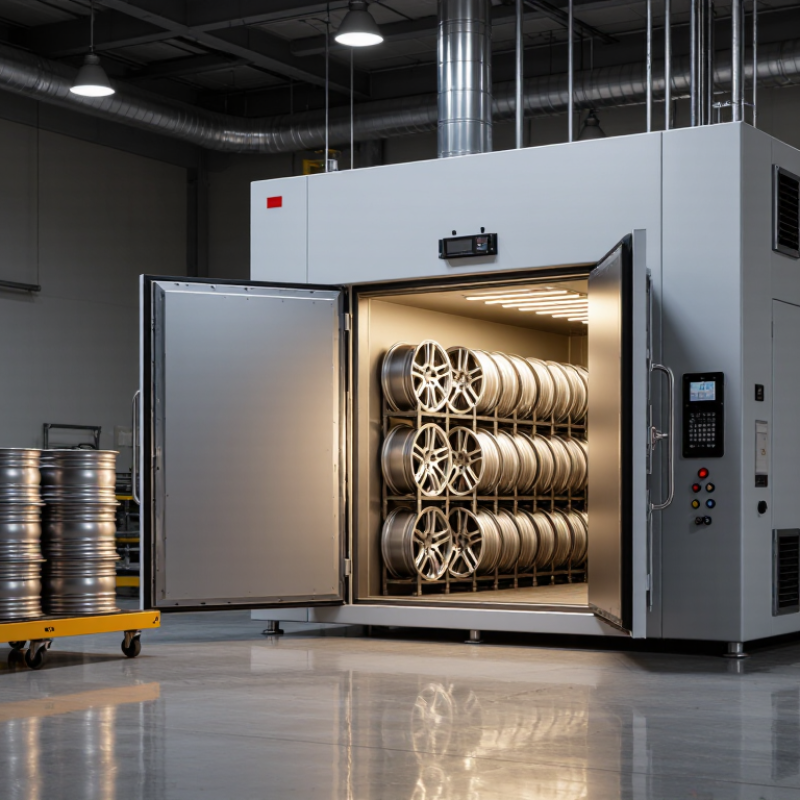
An alloy wheel curing oven hardens its coating through controlled heat, airflow, and time. After coating, operators load wheels with space between them so hot air can reach spoke backs and inner barrels. Fans circulate heated air, while sensors monitor chamber conditions.

The key measure is the wheel’s actual metal temperature—not simply the oven display. A thermocouple attached to a representative wheel can show how quickly the metal heats and how long it stays within the coating’s specified cure window.

The cure schedule depends on the coating chemistry and wheel mass. Follow the coating supplier’s technical data sheet; one fixed temperature and dwell time will not suit every wheel. A clean-looking finish can still be under-cured. That is easy to miss.

The International Energy Agency reports that process heat accounts for about 75% of industrial energy use, highlighting why oven insulation, door seals, and efficient loading matter. This figure describes industry broadly, not wheel ovens specifically.

In practice, record metal-temperature curves for different wheel designs, then check coating hardness and adhesion. Small details matter: crowded racks can create cold spots, while excessive exhaust can waste heat. Even a careful setup needs periodic verification.

Key Criteria for Comparing Curing Oven Designs

When comparing alloy wheel curing oven designs, start with usable chamber size, not the outer dimensions. A wheel needs clearance for loading, airflow, and safe movement on its rack. Check the largest wheel diameter and the number of wheels processed per batch. Small clearances can make a good-looking capacity estimate unrealistic.

Temperature uniformity matters as much as the maximum set point. Ask for test results at several positions in a loaded chamber, not only an empty-oven reading. A probe attached to a representative wheel can help confirm that the metal reaches the coating supplier’s specified cure schedule. Warm air alone does not prove the coating has cured. It is a detail buyers sometimes overlook.

Airflow design affects consistency. Poor circulation may leave cooler zones near the floor or behind tightly spaced wheels. Review fan access, duct cleaning points, and filter replacement needs. Control systems should record actual temperatures and make recipe changes clear to operators. Keep it simple. Insulation, door seals, and heating response also influence energy use and recovery time between batches. A polished specification sheet can still hide awkward loading or difficult maintenance; request a layout drawing and discuss a real production cycle before comparing prices. No design is perfect, and an extra inspection step may be worth the inconvenience.

Seven Alloy Wheel Curing Oven Options for Global Buyers

Global buyers comparing alloy wheel curing ovens should start with the coating process, wheel dimensions, and expected daily volume. Seven useful options include a compact electric batch oven, a larger electric batch oven, a gas-fired batch oven, a convection model with carefully controlled airflow, an infrared-assisted unit, a modular oven with expandable capacity, and a continuous system for steady production. Each serves a different workflow. Small shops may value simple loading; busy lines may need repeatable throughput.

Check the usable chamber size, not just the outside dimensions. A wheel must fit with room for air to circulate around its surfaces. Ask for temperature uniformity data, sensor locations, and records from a representative load. The coating supplier’s specified curing window should guide the process settings. More heat is not automatically better. It can affect coating quality.

Global purchasing adds practical details. Confirm electrical supply or fuel compatibility, controls language, spare-part availability, installation support, and shipping dimensions before ordering. A continuous system may raise output, but it also needs consistent loading and floor space. An infrared-assisted oven may shorten heating time in some setups, yet results depend on the coating and wheel geometry. One detail is easy to miss: ask how the oven behaves during a full, uneven load. I would still compare service response times, not only purchase price. A spreadsheet can miss that.

7 Best Alloy Wheel Curing Ovens for Global Buyers — Seven Practical Oven Options
Oven Option Heating Method Loading and Production Best Fit Key Selection Checks
1. Electric Batch Box Oven Electric resistance elements heat recirculated air inside an insulated chamber. Wheels are loaded in racks or on carts; batches are processed one cycle at a time. Shops with lower or variable throughput, limited floor space, or no suitable gas supply. Confirm supply voltage and available electrical capacity. Check usable chamber dimensions, rack spacing, temperature uniformity, and insulation.
2. Gas-Fired Batch Oven A gas burner heats the chamber directly or through a heat exchanger, depending on the design. Batch operation with rack or cart loading; the chamber is heated for each production cycle. Facilities with an appropriate gas connection and production needs that justify gas-fired equipment. Verify local fuel type and pressure, ventilation and exhaust requirements, burner controls, and applicable installation rules.
3. Walk-In Curing Oven Typically uses electric or gas heating with forced-air circulation. Large chamber allows workers or carts to move wheels in and out; usually batch-based. Operations curing multiple wheel sets together or handling larger parts and varied rack layouts. Measure door openings and available floor space. Review airflow distribution, safe access, door sealing, and loading arrangements.
4. Trolley or Rail-Loaded Oven Electric or gas heating with circulated air; the exact arrangement depends on the oven design. Wheels are mounted on movable trolleys or suspended from a rail for batch transfer. Workflows that benefit from repeatable loading positions and reduced manual handling between preparation and curing. Check trolley or rail capacity, wheel clearance, handling route, loading height, and whether the support system suits the wheel geometry.
5. Conveyorized Continuous Oven Usually forced-convection heating; electric or gas-fired versions are available. Wheels move through heated zones on a conveyor at a controlled line speed. Steady, higher-volume production with a consistent process flow and compatible upstream and downstream equipment. Match line speed and heated length to the required cure schedule. Check conveyor type, wheel spacing, exhaust needs, and production-line integration.
6. Compact Single-Wheel Oven Usually electric heating with forced-air circulation; configurations vary by application. Processes one wheel or a small number of wheels per cycle. Prototyping, repair work, sample runs, and facilities with limited production volume. Confirm that the chamber fits the largest wheel and fixture. Review controls, loading access, temperature monitoring, and available electrical supply.
7. Convection Oven with Infrared Assist Combines infrared heating with circulated hot air; the balance depends on the system design. Can be configured for batch processing or incorporated into a production line. Processes where faster surface heating is desired, provided the wheel geometry and coating process suit infrared assistance. Assess line-of-sight heating, shadowed areas, wheel rotation or positioning, temperature measurement, and compatibility with the coating supplier’s cure instructions.
Important: The correct cure schedule depends on the coating manufacturer’s technical data and the part’s actual metal temperature—not only the oven air temperature. Confirm the required time and temperature, temperature uniformity, local electrical or fuel supply, ventilation, and applicable safety requirements before selecting an oven.

How to Match Oven Capacity to Production Needs

Choosing an alloy wheel curing oven starts with finished wheels per shift, not the largest chamber available. Record the number of wheels in each batch, average loading time, and the coating’s specified cure schedule. Estimate cycles per shift, including warm-up, unloading, and cleaning. A 24-wheel load is not useful if racks restrict airflow or loading takes too long. Leave space between wheels, and check the usable chamber dimensions with the racks installed.

Tips: Plan for peak demand, not a quiet week. Ask for a loaded-cycle estimate based on your wheel sizes, rack layout, and target part-metal temperature. Compare usable volume, airflow, and heat recovery time, not just the advertised wheel count. Real loads vary.

A smaller batch oven may suit a workshop with mixed orders, while steady high-volume production may need more capacity or a continuous process. Match the choice to actual shift patterns and coating requirements. Keep a record of trial loads and temperature readings; oven-air temperature alone may not show how quickly a wheel reaches cure conditions. The calculation will be imperfect. Loading habits often change after installation, so review capacity using real production data.

7 Best Alloy Wheel Curing Ovens for Global Buyers — Matching Capacity to Production Needs

How to read this: This illustrative planning scenario assumes six complete oven cycles per 8-hour shift, with 75 minutes per cycle for heating, curing, cooling, and handling. Estimated output equals batch capacity multiplied by six; actual throughput depends on wheel size, rack spacing, cure profile, loading time, and production downtime. Figures are not manufacturer specifications.

Open chat
Scan the code
Bendet Sales Assistant
Hi There👋,
Thank you for visiting our website, How can I help you?