








A Silicone Cookie Spatula can look perfect in a supplier’s catalog and still struggle beneath a warm, delicate cookie. For bulk buyers, that mismatch can mean broken products, slower packing, and cartons of tools nobody wants. Details matter. A thin leading edge helps lift cookies cleanly, while a reinforced core supports heavier portions without excessive bending. Handle comfort also deserves attention when bakery staff repeat the same movement hundreds of times.
Culinary educator Julia Child once advised, “Learn from your mistakes, be fearless, and above all have fun.” Her words concern cooking, rather than commercial spatula purchasing, but the lesson about learning from mistakes applies. Test before committing. Try supplier samples with soft chocolate-chip cookies, crisp shortbread, and crowded baking trays. Check whether the head slides underneath without pushing cookies across the surface. Inspect the joint after washing. A seamless design may simplify cleaning, but it does not automatically guarantee durability or comfortable handling. We can overvalue appearance. An attractive color range means little if replacement batches arrive with inconsistent stiffness.
This guide to the 10 best options focuses on practical purchasing criteria: lifting performance, construction, supplier documentation, and total cost. Buyers should request food-contact compliance evidence appropriate to their destination market and confirm the manufacturer’s stated temperature limits. Compare minimum order quantities, packaging, sample availability, and replacement policies alongside unit prices. No single Silicone Cookie Spatula will suit every bakery, retailer, or catering operation. The strongest choice earns its place through repeatable performance—and a sample that survives your actual workflow.
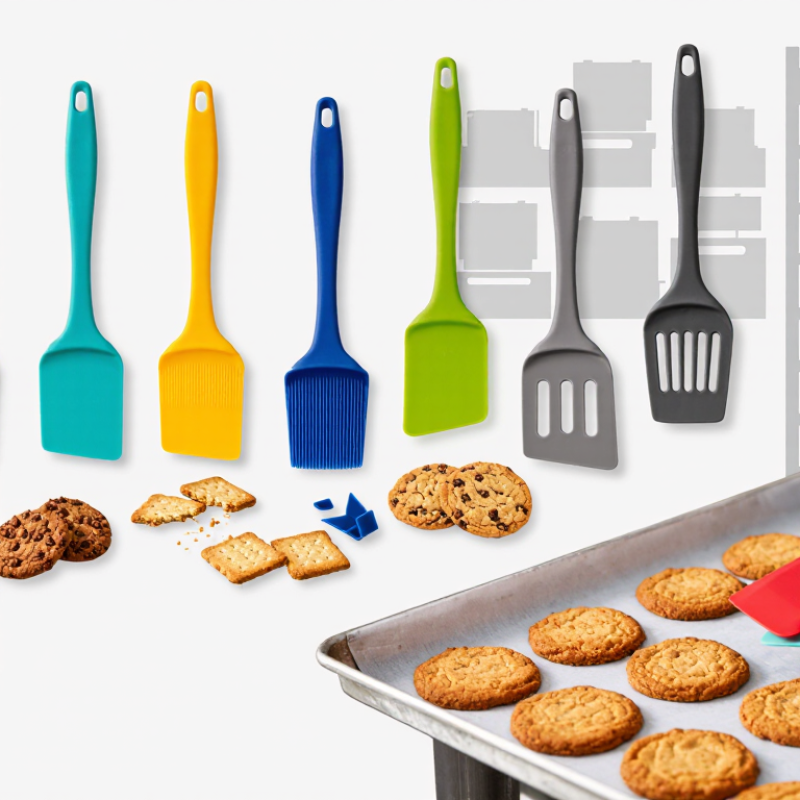
Silicone cookie spatulas are small turners with flexible silicone heads, sometimes supported by a rigid inner core. Their thin edges slide beneath baked cookies, while broader surfaces support soft centers during transfer to cooling racks.
Timing matters.
Fresh cookies can buckle if lifted before their edges firm up. For bulk buyers, blade thickness, handle strength, and consistent dimensions deserve closer attention than color choices.
The United Nations Environment Programme’s Food Waste Index Report 2024 attributes 28% of global food waste to food service. That figure provides purchasing context; it does not measure how much waste silicone spatulas prevent. Still, transferring fragile cookies intact is a practical concern for bakeries handling repeated batches.
Check the edges. A thick, blunt lip can push a warm cookie across parchment instead of lifting it. A wider blade may support oversized cookies, but it can feel awkward between closely spaced portions.
Tips:
For bulk buyers comparing silicone cookie spatulas, material descriptions deserve more attention than color choices. “Food-grade silicone” alone provides little evidence of suitability for repeated contact with warm, fatty cookies. Ask suppliers to identify the silicone formulation, curing method, and intended food-contact conditions. Platinum-cured silicone can offer low residual byproducts, but curing chemistry alone does not establish safety. Documentation matters. Request current test reports covering the finished spatula, including its pigments, coatings, and any internal reinforcement.
Heat resistance needs context: a stated maximum temperature may describe brief exposure rather than continuous use. A spatula rated for 230°C should not automatically be considered suitable for resting against a hot baking tray. Ask for separate limits covering continuous use, short exposure, and dishwasher cleaning. Check the joints. During sample evaluation, lift cookies from a warm tray and inspect the blade for bending, tackiness, or separation. A thin edge slides beneath delicate cookies easily, although it may struggle with heavier, loaded portions.
Food-contact requirements vary by destination market, so request documentation relevant to where the spatulas will be sold. Reports should identify the tested product, laboratory, test conditions, and applicable requirements. Migration testing should reflect intended contact with foods, including fatty ingredients where relevant. Odor checks can flag problems, but an odorless spatula is not proof of compliance. One sample cannot represent an entire shipment; agree on batch traceability and inspection criteria before ordering thousands.
When comparing silicone cookie spatulas, request documentation for the intended food-contact conditions. The chart shows U.S. regulatory extractive limits for rubber articles intended for repeated use under 21 CFR 177.2600, a relevant compliance framework for qualifying silicone rubber utensils.
How to use these figures: For aqueous-food applications, the regulation specifies extraction in distilled water at reflux; for fatty-food applications, it specifies n-hexane at reflux. Values are maximum permitted extractives per square inch of food-contact surface, not measurements from commercial spatulas. The succeeding two-hour limits apply to a separate extraction period following the initial seven hours.
Bulk purchasing takeaway: These limits do not establish silicone grade or maximum operating temperature. Request supporting food-contact test reports and a documented heat rating for the finished spatula, including its handle, core, and any bonded components.
Source: 21 CFR 177.2600(e)–(f): Rubber articles intended for repeated use .
A silicone cookie spatula needs a thin leading edge that slides beneath warm cookies without folding or tearing their centers. Compare blade dimensions against your actual cookie sizes, especially when buying for several production lines with different portion standards. A blade around 2.5 inches wide is a useful sample size to evaluate, rather than a universal requirement. Test the edge. Excessive thickness can push soft cookies across the tray instead of lifting them cleanly. A flexible tip helps, but the center needs enough support to carry heavier cookies.
Check the stated temperature limit for the complete utensil, including its handle and internal reinforcement, before comparing supplier claims. Request food-contact documentation relevant to your destination market and the exact product being supplied. Generic certificates may not cover every color or material formulation. One-piece construction reduces exposed joints where grease and crumbs can collect. Inspect samples closely. Look for rough seams, sticky surfaces, and gaps around any handle connection.
For bulk orders, compare unit weight, carton quantities, replacement terms, and consistency between samples and production stock. Ask whether quoted dimensions include manufacturing tolerances. A comfortable handle should stay secure during repeated transfers, including when hands are slightly damp. Dishwasher suitability also deserves verification under your cleaning conditions. A softer blade might protect delicate cookies yet struggle with dense ones; choosing maximum flexibility can be a mistake.
The best silicone cookie spatulas for bulk buyers depend on cookie size, tray spacing, and washing routines. Ten useful designs deserve comparison: narrow, wide, thin-edged, beveled, firm-core, flexible, mini, offset, seamless, and reinforced-neck spatulas. These features can overlap. Narrow heads fit crowded trays. Wide heads support large cookies, though they can crowd smaller baking sheets. Thin edges slide beneath delicate cookies; beveled edges help release firmer bases. Fit matters.
Firm-core spatulas offer support for heavier cookies, while flexible heads bend around tray edges. Too much flexibility can leave warm cookies sagging during transfer. Mini versions suit bite-sized batches. Offset handles provide knuckle clearance, but their shape may complicate storage. Seamless construction removes a head-to-handle joint that otherwise needs careful cleaning. Reinforced necks may resist bending, although extra thickness can reduce access beneath cookies. A stiff spatula once seemed like the obvious choice to me. That assumption deserves questioning: fragile cookies need gentle handling, and stiffness alone proves little.
Tips: Request samples before ordering cartons. Compare all ten designs using the same cookie sizes and cooling times. Try lifting a warm, 8-centimeter cookie and a fully cooled, 4-centimeter cookie. Check for torn bases, awkward grips, and trapped wash water. Ask suppliers for food-contact documentation relevant to your market and written temperature limits. Confirm carton quantities, dimensions, and replacement terms. Small details matter. A cheaper unit may offer poor value if inconsistent edges slow every tray.
Comparing silicone cookie spatulas for bulk purchasing starts with the delivered cost per usable piece. Request separate quotes for 500, 1,000, and 3,000 units, including packaging, freight, and any customization charges. These quantities are comparison points, not standard supplier minimums. Check the arithmetic. A $0.12 unit discount saves $120 on 1,000 spatulas, but additional shipping charges can erase that saving. Ask whether mixed colors count toward the minimum order quantity. Confirm carton dimensions, too, since bulky packaging can increase transport and storage costs.
Samples deserve scrutiny. Test the edge beneath thin cookies and check whether the handle flexes excessively under heavier portions. Inspect the connection between the silicone head and its core after repeated washing. Request documentation supporting food-contact suitability for your destination market and the supplier’s stated temperature limits. A neat sample can create too much confidence; production batches may still vary in thickness, finish, or stiffness. Specify acceptable defects in writing, including exposed cores, loose heads, and rough edges.
Reliability needs evidence. Ask suppliers to distinguish manufacturing lead time from shipping time and explain how they handle delayed production. Request recent inspection records where available, plus written replacement terms for defective goods. A small trial order costs more per unit, which makes it tempting to skip. That saving deserves reconsideration when a failed batch could interrupt bakery operations or leave retail orders unfilled. Record the approved sample’s dimensions and weight so receiving staff have something concrete to compare.
Compare ten silicone spatula designs for cookie preparation, baking, and serving. Select by intended use, evaluate total landed cost, and verify order terms and product documentation before purchasing.
| Spatula Design | Suitable Cookie Application | Specification to Verify | Pricing Factors | Order Size Considerations | Supplier Reliability Evidence |
|---|---|---|---|---|---|
| Mini Silicone Turner | Lifting small cookies and transferring individual portions. | Blade width, leading-edge thickness, and clearance beneath the cookie. | Blade construction, reinforcement, handle material, and individual packaging. | Confirm the minimum order per size and color, plus the number of units per carton. | Production samples that demonstrate clean lifting without excessive blade bending. |
| Wide Silicone Turner | Supporting larger cookies during transfer from a baking tray. | Usable blade area, stiffness under load, and handle attachment. | Blade dimensions, silicone quantity, internal support, and shipping volume. | Request quantity breaks for the same blade size, construction, and packaging specification. | Consistent blade dimensions and documented checks for loose or damaged handles. |
| Thin-Edge Silicone Turner | Sliding beneath cookies where a thin leading edge improves access. | Actual edge thickness, edge flexibility, and resistance to tearing. | Edge geometry, tooling requirements, reinforcement, and inspection requirements. | Ask whether a modified edge requires new tooling or a separate production minimum. | Samples from the intended production mold and repeatable edge-quality inspection. |
| Slotted Silicone Turner | Lifting cookies and serving baked items with loose crumbs. | Slot dimensions, blade support, and ease of cleaning around openings. | Blade design, molding complexity, reinforcement, and finishing requirements. | Confirm that slotted and solid versions have separately stated order minimums. | Inspection criteria for blocked slots, molding flash, and tears around openings. |
| Offset Silicone Turner | Reaching beneath cookies while keeping the handle above the tray surface. | Offset height, blade angle, balance, and clearance at the tray rim. | Handle geometry, support material, assembly, and carton dimensions. | Verify carton quantity and freight volume for the selected offset shape. | Dimensional checks and samples demonstrating stable blade alignment during use. |
| One-Piece Silicone Scraper | Scraping cookie dough from bowls and folding ingredients. | Continuous exterior, head flexibility, and stiffness through the handle. | Overall size, silicone formulation, internal core, and surface finish. | Check whether custom colors require a separate minimum production quantity. | Documented material traceability and checks for exposed cores, cracks, or surface defects. |
| Firm-Core Silicone Scraper | Mixing and scraping thicker cookie dough when greater handle stiffness is needed. | Core material, silicone coverage, and performance with the intended dough consistency. | Core construction, silicone thickness, bonding, and durability requirements. | Specify the same core and silicone construction across all quoted quantity tiers. | Checks for core exposure, separation, and permanent deformation under the agreed test conditions. |
| Spoon-Shaped Silicone Spatula | Scooping dough, folding ingredients, and transferring mixtures from a bowl. | Head depth, edge flexibility, and release of the intended dough mixture. | Head volume, material quantity, core design, and packaging. | Confirm whether multiple head sizes can share an order minimum or must be ordered separately. | Approved samples showing consistent head shape and compliance with agreed dimensions. |
| Narrow Silicone Scraper | Removing cookie ingredients from jars and scraping narrow containers. | Head width, usable reach, flexibility, and fit through the intended container opening. | Overall length, reinforcement, mold design, and retail presentation. | Confirm minimum quantities for each length and whether mixed-size cartons are available. | Dimensional inspection and samples tested in the buyer's intended containers. |
| Silicone Spatula Set | Supplying complementary tools for mixing, scraping, and cookie transfer. | Exact tool assortment, individual dimensions, construction, and packaging contents. | Number of pieces, component specifications, packing labor, and inserts or gift boxes. | Distinguish the minimum number of sets from the total number of individual tools. | Pack-out inspections, component counts, and material documentation covering every included tool. |
Hein Minnie
Cell nr: +27 (0) 82 564 6501
Email: sale@thecirclemachine.com
Hein Minnie Jnr
Cell nr: +27 (0) 84 284 7234
Email: sale@thecirclemachine.com
Address:
10 Apsey Street,
Heidelberg,
Gauteng,
1441
Bendet Engineering Services (PTY) LTD was established in 1987. Our team of engineers and draughtsman are ready to deliver a complete turnkey solution, from the design phase to commissioning. A dedicated team that consists of electrical, mechanical and industrial engineers, we are able to offer a comprehensive service to our clients.