What Are China’s Top IR Imaging Sensor Manufacturers?
China has become a major force in thermal imaging, supporting applications from industrial inspection to firefighting and security. This article examines China’s top Ir Imaging Sensor manufacturers and explains what separates established suppliers from emerging competitors. Names such as Guide Infrared, DALI Technology, HIKMICRO, InfiRay, and GSTIR appear frequently in professional procurement discussions. However, market visibility does not always equal the best technical fit.
The market is changing.
A reliable evaluation should consider more than resolution or detector format. It should examine spectral range, pixel pitch, thermal sensitivity, frame rate, calibration stability, production capacity, and long-term technical support. These details matter when a sensor must identify a hot electrical connection, monitor machinery, or operate in dust and changing temperatures. Datasheets provide useful evidence, but field performance can differ under real operating conditions. Specifications can mislead.
This overview will compare manufacturers through practical and verifiable criteria, including product breadth, research capability, manufacturing experience, certification practices, and customer applications. It will also distinguish complete thermal cameras from standalone detector modules, because the two markets require different purchasing decisions. Some companies lead in high-volume commercial systems, while others focus on specialized defense, industrial, or scientific solutions. No ranking is permanent. Technology cycles, export requirements, supply-chain conditions, and customer feedback can quickly change a manufacturer’s position. Readers should confirm current product information directly with suppliers before making a technical or commercial decision.
What Are Infrared Imaging Sensors and How Do They Work?
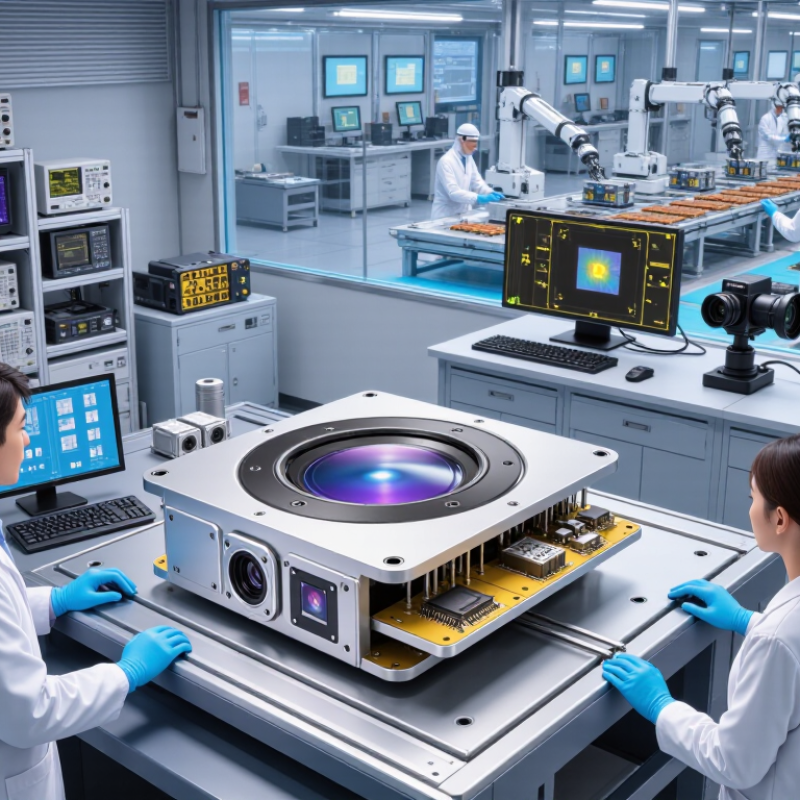
Infrared imaging sensors detect radiation beyond visible red light, usually in the mid-wave or long-wave infrared range. They do not capture ordinary photographs. Instead, they measure energy related to an object’s temperature and convert it into electrical signals. A warm hand appears clearly against a cooler wall because its emitted infrared energy differs.
The process begins with infrared optics focusing radiation onto a detector array. In an uncooled sensor, each pixel often contains a tiny microbolometer. Its electrical resistance changes when absorbed radiation warms it. The readout circuit measures these changes, while software turns them into a temperature-colored image. Cooled sensors can provide greater sensitivity, especially in demanding low-light conditions, but they require more complex cooling systems and careful maintenance.
In field testing, calibration matters as much as pixel count. Emissivity, reflected heat, humidity, and window materials can change the apparent temperature. A shiny metal pipe may look cooler than it really is because it reflects the surrounding room. That result can mislead an inexperienced operator. I have also found that higher resolution does not automatically mean better inspection; stable optics and accurate calibration often matter more. Manufacturers therefore evaluate sensitivity, spectral range, thermal stability, frame rate, and software performance together. Small errors remain possible, particularly around reflective surfaces or rapidly changing temperatures.
Infrared Imaging Sensor Spectral Bands
Infrared imaging sensors detect thermal or reflected radiation across different wavelength regions. The chart shows commonly used approximate spectral bands; exact boundaries may vary by industry or technical standard.
How it works: The sensor converts incoming infrared photons into an electrical signal. Optics, filters, detector materials, and cooling requirements are selected according to the target wavelength range and application.
What Defines a Leading Chinese IR Imaging Sensor Manufacturer?
What defines a leading Chinese IR imaging sensor manufacturer? Reliable performance begins at the wafer, not the product brochure. Yole Group’s 2024 infrared imaging analysis highlights continuing demand for smaller pixel pitches, including 12 μm designs. A capable manufacturer should therefore demonstrate stable pixel uniformity, low noise, and repeatable production at scale. For practical systems, buyers often examine NETD below 40 mK, calibration drift, and performance across temperature changes. A sensor that works in a laboratory may fail beside a hot engine or a cold warehouse door. Field testing matters.
Consistency is the harder measure. The 2024 MarketsandMarkets report estimates continued expansion in the global thermal imaging market, driven by industrial inspection, security, automotive, and healthcare applications. That growth increases pressure on Chinese suppliers to provide documented yields, traceable calibration records, and dependable after-sales engineering. Fast sampling also matters. Some machine-vision applications require compact packages and frame rates above 50 Hz. Others value long-wave sensitivity more than speed. There is no universal specification.
A strong manufacturer also supports custom optics, firmware integration, and environmental testing. ISO 9001 certification helps, but paperwork alone proves little. In my experience, engineers learn more from a supplier’s failure analysis than its polished presentation. Response time, replacement procedures, and transparent limitations reveal maturity. The assessment is not perfectly clean. Reported specifications may vary with test conditions, and independent validation remains necessary before purchase.
Which Chinese Companies Lead the IR Imaging Sensor Market?
China’s IR imaging sensor market is led by several specialized manufacturers, rather than one dominant company. The strongest groups usually combine detector design, wafer production, packaging, and camera integration. Their products serve industrial inspection, firefighting, transportation, medical screening, and security applications. This vertical capability matters because sensor reliability often depends on packaging quality, not only pixel resolution.
MarketsandMarkets’ 2024 Thermal Imaging Market report values the global market at roughly US$7 billion in 2024. It also forecasts strong growth through 2029, supported by industrial automation and predictive maintenance. Yole Group’s recent infrared imaging analysis identifies uncooled microbolometers as the main volume technology. Chinese suppliers are particularly competitive in this segment. Several domestic manufacturers now offer 12-micron and 17-micron detector formats, while higher-end development is moving toward smaller pixels and better noise performance.
The market leaders are generally publicly traded sensor makers, defense-electronics groups, and private manufacturers with dedicated infrared teams. Their advantages include local supply chains, flexible customization, and faster delivery for domestic projects. Yet leadership is not measured by shipment volume alone. Calibration stability, thermal sensitivity, lifetime testing, and software integration remain decisive. Independent evaluations sometimes reveal uneven performance between laboratory samples and field units. That gap deserves more attention. Reports also suggest that export certification, qualification cycles, and limited access to advanced equipment can slow progress. Chinese manufacturers are advancing quickly, but claiming complete technological independence would be premature.
What Technologies Distinguish China’s Top IR Sensor Makers?
China’s leading infrared imaging sensor manufacturers compete through process control, not slogans. Their strongest advantage is often high-volume wafer production. Yole Group’s 2024 analysis of uncooled infrared imaging identifies shrinking pixel pitches and improved wafer-level packaging as major industry directions. Many commercial designs now target 12-micrometer pixels and sub-40 mK NETD.
The technology stack matters. Vanadium-oxide and amorphous-silicon microbolometers offer different trade-offs in sensitivity, uniformity, and manufacturing yield. Advanced readout circuits can reduce noise while preserving frame rates in compact cameras. Wafer-level vacuum packaging also lowers size and assembly costs. Small details matter. A poorly controlled package can weaken an otherwise excellent detector.
Chinese manufacturers are also developing edge-based image processing, multi-point calibration, and shutterless correction. These features help cameras maintain stable images across changing temperatures. MarketsandMarkets estimates that the global thermal imaging market may grow from about 4.7 billion dollars in 2023 to 7.5 billion dollars by 2028, at roughly 9.8% CAGR. That growth rewards scalable engineering. However, specifications can mislead. NETD alone does not guarantee useful images in fog, reflective scenes, or low-contrast targets. Field testing, calibration drift, and long-term reliability still separate capable products from merely impressive datasheets.
How to Compare China’s IR Imaging Sensor Manufacturers?
Comparing China’s IR imaging sensor manufacturers requires more than checking pixel counts or export prices. According to MarketsandMarkets’ 2024 Thermal Imaging Market report, the global market may grow from about USD 4.1 billion in 2024 to USD 6.7 billion by 2029. This growth increases supplier choices, but also makes technical verification harder. Compare NETD, resolution, frame rate, spectral range, calibration stability, and response time under identical test conditions. A 640 × 512 sensor with lower NETD may reveal warmer objects more clearly than a higher-resolution sensor with unstable noise performance. Numbers can mislead.
Review manufacturing evidence, not only brochures. Ask for third-party test reports, ISO 9001 certification, environmental test records, and sample images from hot, cold, humid, and low-contrast scenes. MarketsandMarkets also identifies defense, industrial inspection, automotive, and security as major thermal imaging application areas. Each sector requires different reliability priorities. Check wafer sourcing, detector consistency, firmware updates, repair timelines, and documented product lifecycles. One overlooked detail is calibration drift after repeated temperature changes. It can damage real-world accuracy. No comparison is perfect.
Tips: Build a weighted scorecard before contacting suppliers. Give technical performance 40%, reliability 25%, support 20%, and total cost 15%. Test at least three samples from each shortlisted manufacturer. Keep the same lens, target distance, ambient temperature, and software settings. A low-cost module may win early. Its long-term service cost may prove otherwise.