








How to Choose a High Torque Brushless DC Motor

Choosing a High Torque Brushless Dc Motor begins with the load, not the catalog’s largest number. A conveyor that starts under a full bin needs different performance from a camera gimbal that moves smoothly at low speed. Peak torque can look impressive on a specification sheet. Continuous torque, heat, and speed range reveal more about everyday performance.

Dr. Thomas A. Lipo is a respected researcher in electric-machine design. A useful selection principle, consistent with his field of work, is: “Judge torque together with thermal limits and operating speed.” This is an editorial paraphrase, not a verified verbatim quotation. It matters because a motor may deliver a brief surge yet overheat when asked to hold a load. Check the torque-speed curve, rated current, winding temperature limits, and cooling method. Then compare those values with the real duty cycle, including starts, stops, and time spent under load.

The right High Torque Brushless Dc Motor is not always the biggest or most expensive option. Match the motor to the gearbox, controller, power supply, and mounting space. A compact motor may fit neatly but struggle to shed heat behind a sealed panel. Leave room for that possibility. Specifications can be incomplete, and actual performance depends on the full system. Test the intended load where practical, and treat unexplained gaps in the data as a reason to ask questions. A careful choice should deliver the required torque without trading away service life, efficiency, or predictable control.
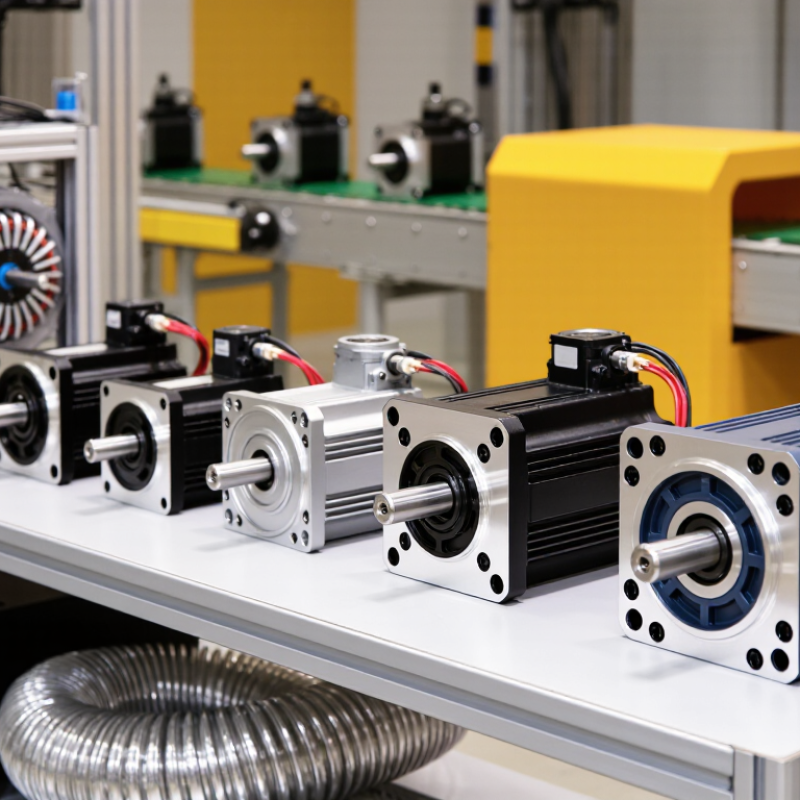
How to Choose a High Torque Brushless DC Motor

Define the Torque and Speed Requirements for Your Application

Start by defining what the motor must move, how quickly it must accelerate, and how long it will run. Record the load’s mass, direction of travel, and operating pattern. A conveyor carrying a steady load has different needs from a mechanism that starts and stops every few seconds. Do not size the motor from a single peak figure. Estimate the torque needed during normal operation and during startup.

Peak torque may be available only briefly. Continuous torque matters more for sustained work. Check the motor’s torque-speed curve at your intended operating speed; torque usually falls as speed rises. A motor that looks powerful at low speed may not meet the load’s needs at higher speed. Keep a margin, but avoid oversizing without reason. Extra capacity can add cost and make control less responsive.

Include acceleration, friction, and any gearbox losses in your estimate. An early calculation is rarely perfect; friction and alignment are easy to underestimate. For example, a small wheel rolling on a smooth bench may behave differently under a full cart on a rough floor. Compare the calculated requirements with the motor’s continuous ratings, then test the actual assembly under its expected duty cycle. Watch temperature, startup behavior, and speed under load. Real measurements matter. If the motor slows noticeably or heats quickly, revisit the load estimate and operating schedule.

How to Choose a High Torque Brushless DC Motor - Define the Torque and Speed Requirements for Your Application

Example Application Required Continuous Output Torque Required Peak Output Torque Peak Torque Duration Operating Speed Duty Cycle Mechanical Power at Continuous Operating Point Key Selection Consideration
Low-speed conveyor drive 4 N·m 8 N·m Up to 5 seconds during startup 120 rpm 80% 50 W Check startup torque with the conveyor fully loaded and allow for gearbox losses.
Automated lift or positioning axis 6 N·m 18 N·m Up to 2 seconds during acceleration 60 rpm 30% 38 W Account for the lifted mass, acceleration, holding method, and required stopping accuracy.
Mobile robot wheel drive 12 N·m 30 N·m Up to 3 seconds on ramps or over obstacles 90 rpm 60% 113 W Calculate wheel torque from vehicle mass, wheel radius, slope, and the number of driven wheels.
Industrial mixer with viscous material 20 N·m 50 N·m Up to 4 seconds during material startup 45 rpm 70% 94 W Measure load torque across the full process; material viscosity can change with temperature.
Rotary indexing table 3 N·m 9 N·m Up to 1 second during rapid indexing 300 rpm 40% 94 W Include the inertia of the table and workpiece when sizing acceleration torque.
Compact cable or web tension drive 10 N·m 25 N·m Up to 2 seconds during tension correction 75 rpm 50% 79 W Consider changing roll diameter, required tension, and safe limits for peak torque.
Mechanical power is calculated at the stated continuous operating point using P (W) = torque (N·m) × speed (rpm) × 2π ÷ 60. These values describe the required application output; select a motor and any gearbox that can meet the torque-speed profile continuously and handle the specified peak torque for its stated duration.

Compare Continuous and Peak Torque Ratings

A high-torque brushless DC motor should be sized by its continuous torque first, not its largest peak figure. Continuous torque is the load it can sustain without exceeding thermal limits under specified conditions. Peak torque is usually available only for a short interval, such as acceleration or a brief load spike. The IEC 60034-1 duty classifications distinguish continuous operation (S1) from short-time duty (S2); check the stated duty and duration before comparing motor ratings. The IEA has reported that electric motors use about 45% of global electricity, making efficient, correctly sized operation important—not just impressive peak numbers.

Compare ratings at the actual operating speed and voltage. A motor listed at 2 N·m continuous and 6 N·m peak is not a 6 N·m continuous motor. Ask for the peak duration, permitted repetition rate, cooling conditions, and winding-temperature limit. A shaft may survive a short burst, while repeated bursts heat the windings and reduce available torque. One caveat: catalog curves can assume ideal cooling. Your enclosure, ambient temperature, and controller limits may change the result.

Tips: Match continuous torque to the sustained load, then verify peak torque against the heaviest brief demand. Leave thermal margin. Check the test conditions, too.

Evaluate the Motor’s Speed-Torque Curve and Efficiency

A high-torque brushless DC motor should be judged across its full speed-torque curve, not by its headline torque. Find the continuous torque rating and the short-duration peak rating. They are not interchangeable. A conveyor starting with a loaded belt needs brief starting torque; a mixer may need steady torque while material thickens. Check the fine print.

Mark your real operating points on the curve: startup, normal running, and any speed changes. Then compare each point with the motor’s efficiency map, if available. Efficiency can fall away from the rated point, even when torque remains adequate. The U.S. Department of Energy’s 2014 Industrial Motor Systems Market Assessment estimates motor-driven systems use about 68% of U.S. industrial electricity. That figure makes system matching worth careful attention; it does not predict one motor’s savings.

Also check how long the motor can hold each load without overheating. A peak-torque figure may describe only a brief interval, while continuous torque depends on cooling and mounting. A clean curve can still mislead. Test the intended controller, supply voltage, and load together when possible, and record winding or case temperature during a realistic duty cycle. Leave margin for friction, starts, and changing loads. Real machinery is rarely as tidy as a datasheet.

Check Voltage, Controller, and Mechanical Compatibility

Choosing a high-torque brushless DC motor starts with the voltage available at the battery or power supply. Match the motor’s rated voltage to the system, and check its permitted operating range. A mismatch can cause weak performance, excess heat, or damage. Check the controller’s voltage limits too.

Current matters just as much. Compare the motor’s continuous and peak current requirements with the controller’s ratings, allowing for brief startup surges. Confirm that the controller supports the motor’s commutation method and any required Hall sensors. A controller that turns the motor may still deliver rough speed control or overheat under load. Small details matter. Verify the wiring diagram before connecting anything.

Then check the physical fit and the real load. Measure the shaft diameter and length, mounting-hole pattern, and available clearance. Make sure the coupling or pulley can handle the motor’s torque without slipping. Consider the driven equipment’s weight, startup resistance, and duty cycle; a motor may meet the torque figure on paper but struggle during repeated starts. Allow room for airflow and inspect the temperature during a cautious test run. Measure twice. A little uncertainty is normal, so test with the actual load rather than relying only on catalog figures.

Assess Thermal Limits, Operating Conditions, and Reliability

How to Choose a High Torque Brushless DC Motor

Thermal limits matter most when high torque comes in repeated bursts, not just during a short bench test. Heat accumulates fast. IEC 60034-1 assigns insulation thermal classes such as F (155°C) and H (180°C); these are winding insulation limits, not recommended everyday operating temperatures. Leave room for ambient heat, current ripple, and cooling restrictions. A motor inside a sealed enclosure may run hotter than the same unit on an open test stand.

Check the real duty cycle: peak torque, burst length, starts per hour, and time to cool. The U.S. Department of Energy’s Improving Motor and Drive System Performance sourcebook estimates motor-driven systems use about 68% of U.S. manufacturing electricity, underscoring how operating choices affect energy use. For reliability, log winding or case temperature during the toughest cycle, then compare results across repeated runs. I would not trust a cool casing alone; it can hide a hot winding. That distinction is easy to miss. Ask for temperature-rise and endurance test data under conditions close to your application, including load, mounting, and airflow. If the data only covers ideal cooling, it may not predict field life. Recheck after installation. Fans clog, grease thickens, and nearby equipment can trap heat.

Open chat
Scan the code
Bendet Sales Assistant
Hi There👋,
Thank you for visiting our website, How can I help you?