






sintered stone has moved from a specialist architectural product into kitchens, bathrooms, hotels, and outdoor living spaces. It is manufactured from carefully selected minerals, compressed under intense pressure, and treated at very high temperatures. This process creates a dense, non-porous surface with a stone-like appearance. The result feels solid beneath the hand, yet it can reproduce delicate marble veins, concrete textures, or warm wood patterns.
Designer Daniel Germani, a long-time collaborator in the sintered-stone sector, has described Dekton as “a blank canvas for design.” That idea explains much of its appeal. Designers can specify large slabs, slim profiles, and coordinated indoor-outdoor surfaces. A kitchen island may carry the same pattern onto a terrace wall. Daily stains usually remain on the surface rather than sinking into it. Cleaning often needs only water and a neutral product.
But popularity should not become marketing shorthand for perfection. Sintered stone is highly resistant to heat, scratches, ultraviolet light, and moisture. It can still chip at exposed edges, especially after poor cutting or careless installation. Heavy slabs also require accurate measurement, trained fabricators, and suitable support. A beautiful surface can fail when the substrate moves.
Environmental claims also deserve closer attention. Long service life can reduce replacement frequency, but manufacturing and transportation still consume energy. The material is impressive, not magical. Understanding its strengths, limitations, finish, thickness, and installation requirements helps homeowners choose it for the right reason: dependable performance with a refined visual character.
Sintered stone is an engineered mineral surface made from selected minerals, pigments, and natural stone-like particles. Manufacturers compress these materials under intense pressure, then fire them at very high temperatures. The European Commission’s 2020 Ceramic Manufacturing BREF places common ceramic firing temperatures around 1,000–1,250°C. This process creates a dense, non-porous slab with consistent color and pattern. Unlike many resin-based surfaces, sintered stone typically contains no polymer binder. It is not natural stone, either. The name can be confusing.
Its popularity comes from practical performance. Many products resist stains, moisture, ultraviolet exposure, and everyday abrasion. They can suit kitchen counters, bathroom walls, floors, and outdoor furniture. The ISO 13006 standard evaluates ceramic products through properties such as water absorption, but sintered stone is not automatically identical across manufacturers. Always check the technical sheet. Grand View Research estimated the global ceramic tiles market at about USD 227 billion in 2023, showing the scale of demand for durable mineral surfaces. That figure does not measure sintered stone alone. Still, it reflects a wider movement toward hard, low-maintenance finishes. The material is tough, but not indestructible. A sharp impact on an unsupported corner may still cause chipping.
Tips: Request water-absorption, slip-resistance, stain-resistance, and thermal-shock test results. Ask whether the slab follows ISO or ASTM testing methods. Inspect the edge detail before installation. Large slabs need accurate support, careful transport, and trained fabrication. Surface samples can also mislead; lighting may change how patterns appear.
Sintered stone begins with carefully selected minerals, such as feldspar, quartz, and natural clays. Manufacturers crush these materials into a fine powder. Mineral pigments may be added for color. The mixture is then distributed across a large forming surface.
High pressure compresses the powder into a dense slab. This stage removes air pockets and improves structural consistency. The slab enters a high-temperature kiln, where heat bonds the mineral particles together. This process imitates the pressure and heat that form natural stone, but it happens within a controlled production cycle. After cooling, the surface may be polished, textured, or given a matte finish. Each slab is inspected for thickness, color, warping, and visible defects.
The process is precise, but not flawless. Small shade variations can still appear, especially between different production batches. That detail is easy to overlook. In practical installation work, checking several slabs together helps create a more balanced layout. Manufacturers also test water absorption, surface hardness, thermal resistance, and resistance to staining. These tests support reliable use in kitchens, bathrooms, walls, and outdoor areas.
Tips: Request a sample before ordering. View it under natural and indoor light. Confirm the slab’s thickness, finish, edge requirements, and recommended cutting method with a qualified fabricator.
What Is Sintered Stone and Why Is It So Popular?
Sintered stone is an engineered surface made from carefully selected minerals. Manufacturers apply intense pressure and heat to compact these materials. The result resembles natural stone, but its performance is more predictable. It feels dense, cool, and remarkably solid beneath the hand. Its low porosity helps resist water, oil, and many everyday stains. That matters in kitchens, bathrooms, and busy commercial spaces.
Its surface also handles heat better than many common decorative materials. A hot pan may leave less risk when placed briefly on the slab. However, heat resistance does not mean unlimited protection. Sudden temperature changes can still stress some surfaces, especially near weak edges or existing damage. Sintered stone also resists scratches well during normal use. Sharp grit, careless dragging, or forceful impact can still cause marks.
Large formats create fewer visible joints and support clean, modern designs. They can cover counters, walls, floors, and furniture panels. The material remains color-stable under regular indoor and outdoor exposure, depending on its formulation. Installation requires accurate measurement, proper support, and skilled edge handling. A beautiful slab can fail when the cabinet beneath it shifts. Maintenance is usually simple, but “maintenance-free” is an overstatement. Dust and spills still need prompt cleaning. Its strength is real, though not magical.
Sintered stone is manufactured from mineral materials compacted under high pressure and heat. Its very low water absorption helps resist staining, moisture penetration, and freeze–thaw damage. The values shown are representative industry ranges rather than specifications for every product; natural stone properties can vary considerably by type and quarry.
Lower water absorption indicates a denser, less porous surface. Sintered stone and porcelain surfaces are commonly classified around 0.5% or less under ceramic-product standards, while natural stone performance varies by material.
Sintered stone is an engineered surface made by compacting and heating selected minerals under intense pressure. Properly tested materials can resist heat, stains, moisture, and daily abrasion. Their dense structure also creates a consistent appearance across large slabs. Still, performance depends on thickness, installation quality, and product specifications.
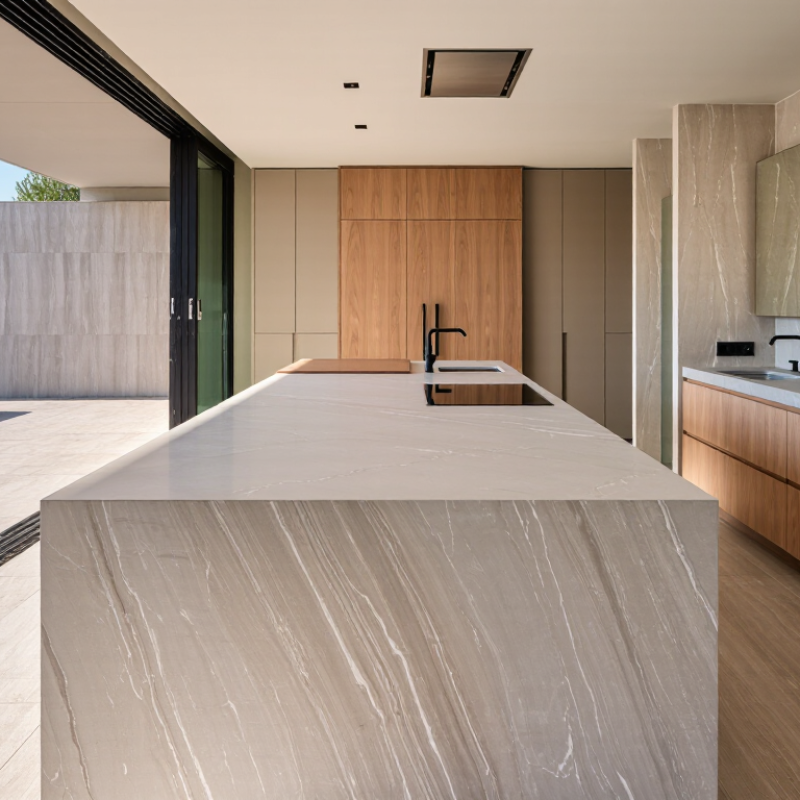
In residential design, sintered stone commonly covers kitchen islands, worktops, splashbacks, bathroom vanities, shower walls, and dining tables. A pale slab can brighten a narrow kitchen, while a darker surface adds contrast beside warm wood cabinets. Shower panels reduce grout lines and make cleaning easier. Outdoor kitchens and balcony tables may also use it, but installers should confirm frost and ultraviolet resistance first. It is not indestructible.
Commercial interiors use sintered stone for reception desks, hotel bathroom walls, restaurant counters, retail shelving, and office meeting tables. Large panels can create a calm, continuous surface behind a reception area. In busy restaurants, the material’s stain resistance may support faster cleaning between service periods. However, heavy public use demands careful attention to corners, joints, substrate movement, and slip ratings. A rushed installation can cause cracking, even when the slab itself performs well.
Designers should review technical data, maintenance instructions, fire classifications, and local building requirements before specifying the material. On renovation projects, small samples can mislead because lighting changes the color dramatically. Full-size mock-ups are safer. Unexpectedly, the most attractive finish may show fingerprints or edge damage more clearly.
Sintered stone is made by compacting mineral particles under intense heat and pressure. In kitchen and bathroom projects, I have found it useful for busy surfaces. It resists heat, scratches, ultraviolet light, and many household stains. A hot pan can usually rest on it briefly without leaving a mark. Its low porosity also reduces the chance of absorbing coffee, oil, or sauce.
However, strength does not mean invulnerability. Edges and corners can chip when struck by heavy cookware. Large slabs may crack if the cabinet support is uneven. Cutting the material requires trained fabricators and suitable equipment, which can increase installation costs. Dark finishes may reveal fingerprints, dust, or fine scratches more clearly. It is not indestructible.
Maintenance is simple, but still necessary. Wipe spills with warm water and a soft cloth before residue dries. For daily cleaning, use a pH-neutral cleaner rather than abrasive powders or harsh chemicals. Avoid dragging ceramic dishes across the surface. Use boards for cutting, even when the surface appears scratch-resistant. I once saw a supposedly permanent stain caused by neglected paint thinner; the mistake was preventable. Follow the installer’s care instructions, because finishes and edge details can vary. Check the surface occasionally for damaged sealants, loose supports, or poorly finished joints.
| Data Dimension | Typical Sintered Stone Characteristics | Practical Benefits | Limitations and Maintenance Requirements |
|---|---|---|---|
| Material Composition | Made primarily from selected natural minerals, such as feldspar, silica, clays, and mineral pigments. | Provides a stone-like appearance with consistent colors, patterns, and technical performance. | The exact composition varies by product. Always check the technical datasheet before specifying the material. |
| Manufacturing Process | Mineral particles are compacted under high pressure and fired at very high temperatures to create a dense slab. | Creates a hard, compact, low-porosity surface suitable for countertops, walls, floors, furniture, and exterior applications. | Because the material is very hard and dense, cutting, drilling, edge profiling, and installation require suitable tools and trained fabricators. |
| Typical Thicknesses | Common thicknesses include approximately 6 mm, 12 mm, and 20 mm, depending on the application and product design. | Thin sheets can reduce material weight for wall cladding and furniture, while thicker slabs provide greater rigidity for countertops. | Thin slabs may require full support or a reinforced substrate. The permitted use depends on slab size, support spacing, and installation method. |
| Approximate Weight | At a typical density of about 2.4–2.7 tonnes per cubic metre, a 6 mm slab weighs roughly 14–16 kg/m², a 12 mm slab 29–32 kg/m², and a 20 mm slab 48–54 kg/m². | Weight can be estimated during structural planning, transport, handling, and cabinet design. | Large slabs are heavy and difficult to handle manually. Adequate access, lifting equipment, and temporary support may be necessary. |
| Water Absorption | Many sintered stone products are manufactured with water absorption at or below approximately 0.5%, although performance varies by product. | Low porosity helps resist water penetration, swelling, and the absorption of many common household liquids. | Open joints, cracked areas, unsealed cutouts, and poorly installed edges can still allow moisture to reach the substrate. |
| Stain Resistance | The dense surface generally resists stains from coffee, tea, oil, wine, food, and many household substances when cleaned promptly. | Suitable for kitchens, bathrooms, dining areas, and other locations where spills are common. | Strong dyes, permanent markers, paint, adhesives, or highly concentrated chemicals may leave marks if allowed to dry. Remove spills as soon as practical. |
| Heat Resistance | The mineral surface tolerates high temperatures better than many polymer-based materials and is generally suitable around normal cookware use. | Hot pots and pans are less likely to cause thermal damage than they would on many plastic-based surfaces. | Sudden, extreme temperature changes or concentrated heat at a vulnerable edge or cutout can cause cracking. Use trivets and avoid direct flame contact. |
| Scratch Resistance | The surface is highly scratch resistant in normal residential and commercial use, but it is not completely scratch-proof. | Maintains its appearance under regular food preparation, foot traffic, and daily use. | Do not drag abrasive objects across the surface. Use a cutting board, and avoid contact with diamond, carbide, or similarly hard materials. |
| Ultraviolet Resistance | Mineral-based sintered surfaces generally have strong resistance to ultraviolet exposure and color fading. | Can be considered for covered outdoor kitchens, façades, balconies, and other areas exposed to sunlight. | Outdoor suitability depends on the complete system, including substrate, adhesives, joints, frost exposure, and local climate conditions. |
| Impact Resistance | The broad surface is hard and durable, but concentrated impacts can damage corners, edges, cutouts, or unsupported areas. | Performs well in demanding environments when properly supported and installed. | Do not strike edges with heavy objects. Edge profiles with larger radii and correctly positioned supports can reduce the risk of chipping. |
| Hygiene and Cleaning | The low-porosity surface does not normally require special sanitation treatments for routine household use. | Easy to clean with warm water, a soft cloth, and a pH-neutral cleaner. | Avoid steel wool, abrasive powders, harsh scouring pads, and unapproved highly acidic or alkaline chemicals. |
| Sealing Requirement | Most fully sintered, non-porous surfaces do not require routine penetrating sealer applications. | Reduces long-term maintenance compared with porous natural stones that may need periodic resealing. | Sealers may still be needed for grout, porous substrates, or specific accessory materials. Follow the product installation instructions. |
| Repairability | Minor surface marks may sometimes be treated by a qualified professional, but deep cracks, major chips, and structural breaks are difficult to repair invisibly. | Good installation and careful daily use can provide a long service life with limited cosmetic maintenance. | Replacement of the damaged section may be the most reliable solution. Keep spare material when the surface has a distinctive pattern or color. |
| Environmental Performance | Made mainly from mineral raw materials and does not normally require periodic chemical sealing during use. | Long service life and low routine maintenance can reduce replacement and maintenance needs over time. | Manufacturing and transportation require significant energy, and end-of-life recycling options depend on local collection and processing facilities. |
| Best-Fit Applications | Common uses include kitchen worktops, bathroom walls, flooring, fireplaces, furniture surfaces, wall panels, and selected exterior cladding. | Combines a natural-stone appearance with low porosity, high hardness, and broad design flexibility. | Application-specific testing is essential for exterior façades, wet areas, staircases, large-format panels, and locations subject to structural movement. |
| Routine Maintenance Schedule | Wipe spills promptly, clean regularly with a soft cloth and pH-neutral detergent, and inspect joints and edges periodically. | Routine care is simple and does not normally involve polishing or resealing the main surface. | Repair damaged joints, support defects, or cracked areas promptly to prevent moisture penetration and further damage. |
Hein Minnie
Cell nr: +27 (0) 82 564 6501
Email: sale@thecirclemachine.com
Hein Minnie Jnr
Cell nr: +27 (0) 84 284 7234
Email: sale@thecirclemachine.com
Address:
10 Apsey Street,
Heidelberg,
Gauteng,
1441
Bendet Engineering Services (PTY) LTD was established in 1987. Our team of engineers and draughtsman are ready to deliver a complete turnkey solution, from the design phase to commissioning. A dedicated team that consists of electrical, mechanical and industrial engineers, we are able to offer a comprehensive service to our clients.