








7 Smart Door Lock Solution Tips for Global Buyers

Choosing the right smart door lock solution is not simply a matter of comparing prices. Global buyers must consider security, local installation conditions, user habits, and long-term service support. A lock that performs well in a dry office may fail in a coastal hotel with salty air. Small details matter.

This guide presents seven practical tips for evaluating smart locks across different markets. It examines authentication methods, battery performance, emergency access, mobile applications, and system compatibility. It also considers certifications, data protection, warranty terms, and installer training. Buyers should request test reports, product documentation, and clear after-sales procedures before placing large orders. A supplier’s confident presentation is not enough.

Look closely.

Reliable procurement requires evidence. Ask how the lock performs after repeated unlocking cycles, low-battery warnings, network interruptions, and temperature changes. Check whether replacement parts are available in your target region. Confirm that the product supports your door thickness, mortise type, and access-control platform. These checks may feel slow, but they prevent expensive modifications later.

No smart door lock solution fits every property. That is the uncomfortable part. A hotel, warehouse, apartment, and private residence need different priorities. Some buyers focus heavily on app features while overlooking mechanical strength or local service capacity. This article encourages a more balanced evaluation, combining technical specifications with real operating conditions. With careful questions and independent verification, global buyers can reduce risk and choose locks that remain practical after installation.
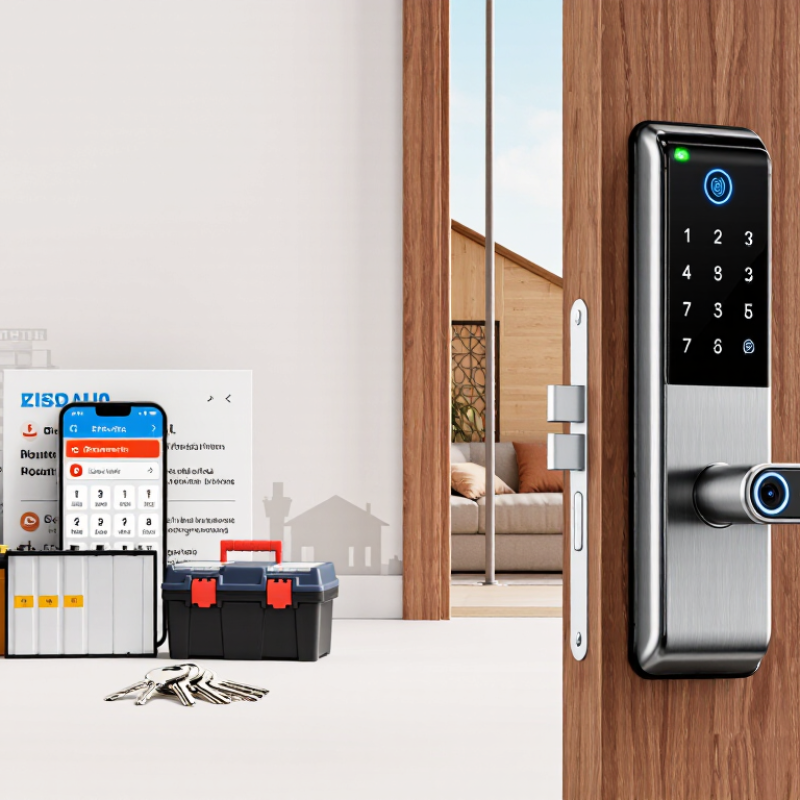
7 Smart Door Lock Solution Tips for Global Buyers

Define Security Needs and Property Access Requirements

Choosing a smart door lock begins with a clear security assessment, not a feature list. Identify who needs entry, when access is allowed, and which doors require stronger protection. A private apartment may need resident codes, while a rental property may require time-limited access for guests or cleaners. Convenience is not security. Details matter.

During a property assessment, inspect the door material, frame strength, lock type, and power supply. A sophisticated lock cannot compensate for a weak frame or loose hinges. Review whether the property needs keypad entry, mobile credentials, physical keys, or a controlled combination. Access logs can help verify entry times, but they should be protected and retained responsibly. Emergency access also needs careful planning. Confirm how the lock behaves during low battery, network failure, or a power outage.

I once focused too heavily on remote control and overlooked daily usability. That assumption failed when users needed reliable entry without a phone. A better plan combines secure authentication with practical backup options. Test the lock from inside and outside, including nighttime use and wet conditions. Check installation instructions and relevant local safety requirements before purchase. Avoid selecting a system solely because it offers more functions. The right solution matches the property’s risks, users, and operating habits. Reassess those needs after occupancy changes, because access requirements rarely remain fixed.

Compare Smart Lock Types, Features, and Connectivity Options

Smart lock selection starts with the door, not the app.
Deadbolt, mortise, rim, and handle locks require different installation checks. Measure backset, door thickness, cylinder size, and available space before comparing features.

Fortune Business Insights estimated the global smart lock market at about USD 2.9 billion in 2023, with strong growth expected through 2032. That growth creates choice, but also confusion.

Bluetooth locks usually provide low-power local access and suit apartments or rental properties. Wi-Fi models support remote control without an additional hub, but they consume more battery power.

Zigbee, Z-Wave, Thread, and Matter-based systems can connect locks with wider home automation networks. According to MarketsandMarkets, the smart home market is expanding rapidly, making interoperability more important for global buyers.

Check regional frequency requirements, encryption support, and gateway compatibility. Do not assume every “smart” lock works everywhere.

Features deserve practical testing.
Keypad access helps when carrying groceries. Temporary codes support cleaners, guests, and property managers. Fingerprint readers may fail with wet or damaged skin. They do.

Battery alerts, mechanical override, tamper detection, and offline operation matter during outages. NIST guidance emphasizes secure authentication, software updates, and protecting connected-device data.

I still prefer a physical backup key for emergencies, although it slightly weakens the minimalist design. Verify local certification, privacy rules, warranty coverage, and replacement battery availability before purchase.

Check Installation Compatibility and Door Hardware Standards

Check installation compatibility before comparing app functions or battery life. MarketsandMarkets’ 2024 Smart Locks Market report projects strong growth through 2028, but adoption can fail at the door. A lock cannot correct an incompatible mortise, cylinder, or latch. Measure the backset, door thickness, edge clearance, and swing direction. Check the frame strike plate too. Small errors matter.

Global buyers should compare local hardware standards carefully. ANSI/BHMA A156.2 covers bored locks, while A156.13 addresses mortise locks in North American applications. European projects may require EN 14846 for electromechanically operated locks. These standards do not make every product interchangeable. A 60 mm backset may replace another 60 mm unit, but screw positions and spindle height can still differ. Do not trust photographs alone.

Installation trials reveal practical problems. A thick metal door may weaken wireless signals. A narrow aluminium frame may leave insufficient space for a battery pack. NISTIR 8259A also recommends clear cybersecurity capabilities for connected devices, including secure updates and device identity. Ask suppliers for dimensional drawings, material limits, certification evidence, and replacement-part plans. Test one door first. That step feels slow. It is often cheaper than correcting a full-site mismatch. I have seen “universal” descriptions create avoidable rework, so procurement teams should treat compatibility as a measured requirement, not a marketing promise.

Evaluate User Management, Data Protection, and Remote Control

Tip 1: Examine user management before comparing design or price. A reliable smart lock should support separate roles for owners, staff, visitors, and service workers. Temporary codes should have clear start and expiry times. Administrators also need activity logs showing who opened the door and when. In real installations, simple permissions prevent many accidental entries. Complex menus often create mistakes.

Tip 2: Treat data protection as a daily operating issue, not a brochure promise. Ask how passwords, access records, and device commands are encrypted during storage and transmission. Multi-factor authentication adds useful protection for administrator accounts. Check whether access logs can be exported, deleted, or retained according to local requirements. Buyers should request written security information from suppliers. Claims without technical details deserve careful questioning.

Tip 3: Test remote control under ordinary conditions. A manager may need to unlock a warehouse while travelling, but poor connectivity can delay commands. Look for instant status updates, failure alerts, and clear confirmation after each action. An offline access method is valuable during network outages. I would test the lock from different regions and with several phones. Remote convenience is helpful, but it should never replace sensible physical access procedures. No system is perfect. Review permissions monthly, because forgotten accounts remain a practical weakness.

7 Smart Door Lock Solution Tips for Global Buyers - Evaluate User Management, Data Protection, and Remote Control

No. Evaluation Area What to Check Practical Benchmark Buyer Action
1 User and Permission Management Check whether the system supports multiple users, administrator roles, temporary credentials, scheduled access, and immediate permission removal. Look for role-based access control, unique user accounts, time-limited guest codes, and an audit trail showing who granted or changed access. Request a live demonstration of adding, editing, suspending, and deleting users. Confirm that former employees and service providers can be deactivated without replacing the lock.
2 Data Protection and Encryption Review how credentials, identity data, event logs, mobile communication, and cloud traffic are encrypted and stored. Prefer TLS 1.2 or newer for data in transit, strong encryption such as AES-256 for stored data, salted password hashing, and separate storage of encryption keys. Ask for a data-flow diagram, retention policy, vulnerability disclosure process, and evidence of independent security testing. Confirm whether biometric data is stored locally or remotely.
3 Remote Control and Connectivity Evaluate remote locking, unlocking, status checks, notifications, gateway requirements, internet dependency, and recovery after an outage. The lock should continue operating locally when the internet is unavailable, while remote commands should use authenticated, encrypted channels and provide clear success or failure status. Test remote access over both Wi-Fi and cellular networks. Verify offline credentials, manual override, low-battery alerts, and a documented process for lost phones or compromised accounts.
4 Authentication Options Compare PIN codes, mobile credentials, RFID or NFC cards, fingerprints, mechanical keys, and multi-factor authentication. Use unique credentials per user, configurable PIN length, lockout or throttling after repeated failures, and at least one non-digital backup method. Test failed-attempt handling, credential revocation, fingerprint enrollment and deletion, emergency access, and operation with gloves or in low-light conditions.
5 Physical Security and Compatibility Check cylinder design, anti-tamper features, door thickness, lock-backset compatibility, weather exposure, and local building requirements. Confirm the product fits the target door type and dimensions. For exposed installations, require a clearly stated environmental rating and operating-temperature range rather than relying on marketing language. Measure sample doors before ordering. Request mechanical durability, fire-door, ingress-protection, and regional conformity documentation where applicable.
6 Power, Reliability, and Fail-Safe Planning Assess battery type, expected endurance, low-power behavior, emergency power, motor performance, and the consequences of electronic or mechanical failure. Require test conditions for battery-life claims. A dependable solution should provide advance low-battery warnings, a physical override, and an external emergency-power option when appropriate. Run repeated lock and unlock cycles on the actual door. Document battery replacement intervals, spare-part availability, warranty coverage, and the emergency opening procedure.
7 Compliance, Integration, and Total Cost Review privacy obligations, regional radio requirements, software updates, API or access-control integration, support coverage, and lifecycle costs. Select solutions with documented update support, exportable event logs, defined data-controller responsibilities, transparent subscription terms, and a clear end-of-service data deletion process. Calculate hardware, gateways, installation, batteries, connectivity, software, training, maintenance, and replacement costs over the planned service life. Obtain written compliance and support commitments.
Buyer checklist: Validate the complete solution in a representative pilot installation before large-scale deployment. Confirm local privacy, electrical, radio, fire-safety, and building-code requirements in every target market.

Assess Certifications, Supplier Support, Pricing, and Scalability

7 Smart Door Lock Solution Tips for Global Buyers

Certification should be checked before comparing prices. Requirements vary by market, building type, and wireless protocol. Look for relevant evidence, such as EN 14846, UL 294, or radio-equipment approvals. A supplier should provide current certificates, test reports, and scope details. A logo alone proves little. According to MarketsandMarkets’ 2024 report, the smart lock market may grow from about USD 2.3 billion in 2023 to USD 4.4 billion by 2028. That growth increases the risk of rushed, poorly documented products. Test the lock in a real door, not only in a laboratory sample.

Supplier support deserves a written service-level agreement. Confirm response times, spare-part availability, firmware policies, and installation training. Ask who handles failed locks during a holiday or network outage. Small details matter. In my procurement reviews, vague support promises often create higher costs than hardware defects. A 2023 Deloitte connectivity study found that organizations continue investing in connected devices, but integration and cybersecurity remain major adoption barriers. Require secure update procedures and clear data-handling responsibilities.

Pricing should include batteries, gateways, software, customs, installation, and replacement units. Compare total cost over three years. The cheapest quotation can become expensive quickly. Scalability also needs proof. Request a pilot with mixed door materials, weak signals, and different user roles. Check whether the platform supports bulk enrollment, audit logs, and local fallback access. I would not approve a large rollout from a perfect pilot alone. Real buildings are less cooperative.

Article Source:

Open chat
Scan the code
Bendet Sales Assistant
Hi There👋,
Thank you for visiting our website, How can I help you?